Mowers & Equipment
Are Robot Mowers Good Enough Yet? A Golf Course Superintendent Judges the Cut
A golf course superintendent's verdict on robot mowers: why the cut beats rotary mowers, where they fall short, costs, and who should buy one.
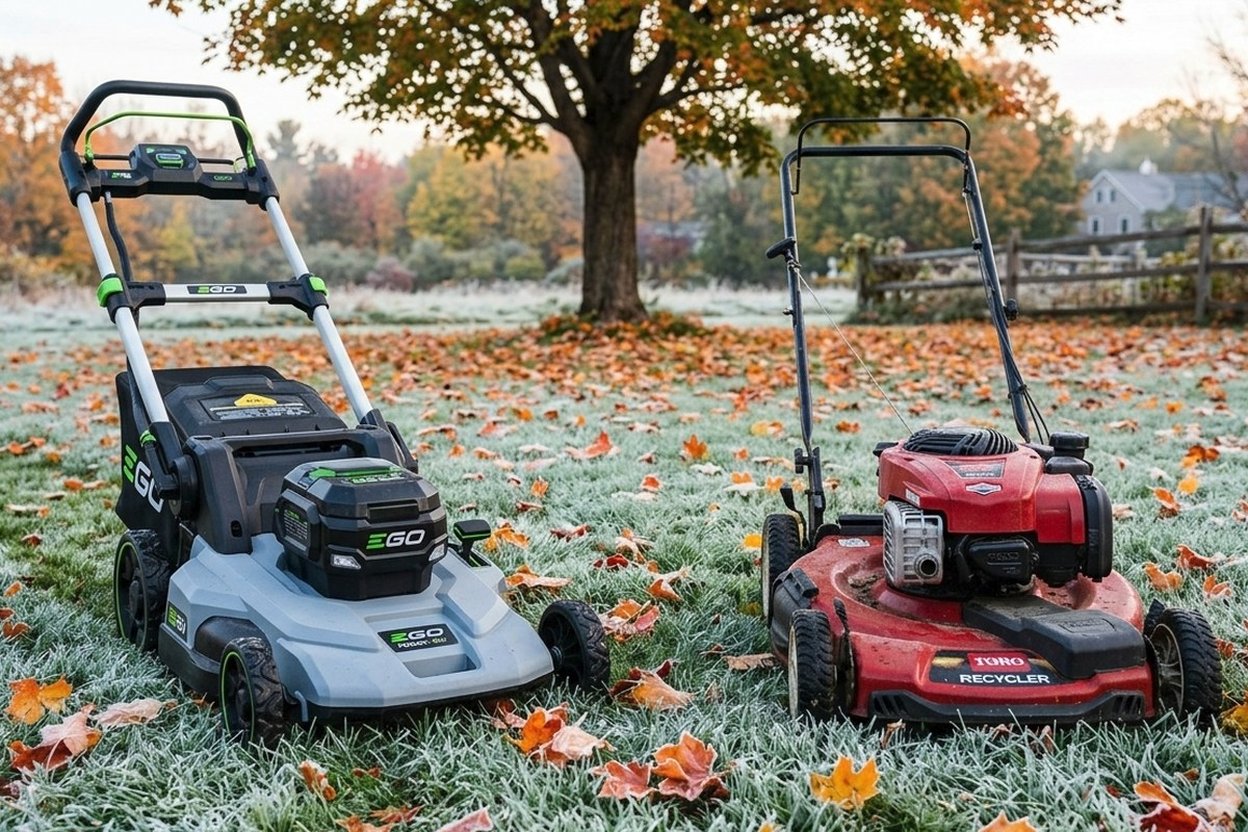
Battery or gas mower in snow country: how cold affects each one, the right fall mowing height, and how to store each over winter.
Jack · golf course superintendent·8 min read·October 6, 2026
Up north, both kinds of mower work fine. The real difference is what happens from November to April. A gas mower can sit in a freezing garage all winter if you deal with the fuel first. A battery mower's deck can stay out there too, but the battery has to come inside. Lithium-ion packs lose capacity in the cold, most brands won't charge them near freezing, and Consumer Reports says to store them between 40°F and 80°F. If you can live with carrying a battery into the house each fall, battery mowers suit a short northern season well.
Here's how each one holds up across the season up north, plus how to put each away.
In snow country you mow from roughly April or May until growth stops in late fall. University of Minnesota Extension says to keep mowing until the grass stops growing, which there is generally around the end of October. Iowa State puts the end in late October or early November, once daytime highs stay below 50°F.
That means your mower sits more months than it runs. A gas engine that sits is how you get gummed carburetors, stale fuel and a spring that starts with a pull cord and a lot of swearing. A battery mower has no fuel to go bad and no carburetor to varnish. For a lawn under about half an acre, that alone makes battery the easier machine to own up north.
Lithium-ion cells slow down as they get cold. The electrolyte inside thickens and the battery gives you less runtime. On a 45°F October morning you may get noticeably fewer passes out of a pack than you did in July. That runtime comes back when the pack warms up.
Charging is the part that can do real damage. Charging a lithium-ion cell below freezing can plate metallic lithium onto the anode, and that capacity is gone for good. Battery makers build chargers to refuse a cold pack. On an EGO, a pack brought in from a cold garage will usually flash red on the charger until it warms up.
What that means for you:
A gas engine doesn't mind a cool fall day. It starts harder when it's cold, so you'll use the choke more, but it has full power at 40°F.
Gas earns its keep on fall leaves. Mulching a thick layer of wet maple leaves takes a lot of power, and a battery mower will drain fast or slow down in heavy, wet material. If you've got big trees and you mulch the leaves into the lawn instead of raking, a gas mower handles that job with fewer stops. With a battery mower, mulch more often while the layer is still thin, and raise the deck a notch on the leaf passes.
The weak spot on a gas mower is fuel. Ethanol-blend gas goes stale while the mower sits, and a short northern season means a long sit. Our post on small-engine fuel and ethanol covers why the carburetor gums up.
The type of mower makes no difference to how you finish the season. Go by the grass:
We go into more detail in when to stop mowing for the season and how short is short enough going into winter.
One tip for battery owners: plan the last mow for a mild afternoon. You get full runtime, the grass is dry, and you aren't trying to finish the lawn on a pack that's down a chunk of its capacity from the cold.
The mower body is just steel or plastic, a motor and a blade. It can sit in an unheated garage. The battery can't.
The gas mower can stay in the cold garage. You just have to take care of the fuel and the engine.
The full list is in mower winter storage: fuel, blades, battery. If you also run a snowblower, the same fuel rules apply. See the snowblower ready check.
If you're shopping now, fall is a reasonable time to buy. Here's roughly what you'll pay for a good self-propelled battery mower. As of October 2026, Consumer Reports' top-rated self-propelled battery models listed from about $449 (Green Machine GMSM6200) to $900 (Greenworks LMB455, Makita XML08PT). The EGO LM2123SP-2 was listed at $769. Those prices include a battery and charger. Extra packs cost real money, so count how many you'll need before you buy.
Go with battery if:
Go with gas if:
A golf course superintendent's verdict on robot mowers: why the cut beats rotary mowers, where they fall short, costs, and who should buy one.
A small lawn under 5,000 square feet needs a basic mower, not a $6,000 one. Learn the cut height, blade, and upkeep that actually matter.
Battery, gas or backpack: how to size a leaf blower to your yard, which specs count, what the noise does to your ears, and where gas blowers are banned.