Fall & Winter
Snow mold on Minnesota lawns last spring: what to change this fall
Snow mold hit many Minnesota lawns last spring. Learn the fall changes that reduce it: final mowing height, leaf handling, and fertilizer timing.

When to put the mower away for winter in the northern US, how to tell the grass has stopped growing, and how low the final cut should go without scalping the crowns.
Jack · golf course superintendent·5 min read·October 1, 2026
Every fall the same question comes up at the end of the driveway: is this the last one? Put the mower away too early and the lawn goes into winter long and floppy. Keep scalping it into November and you strip the plant of the leaf it needs to get through the cold. On a golf course we never guessed at it. We watched the grass, the soil and the weather, and the grass told us when it was done. You can do the same thing in your own yard.
This applies to cool-season lawns, which is what grows anywhere with a real winter: Kentucky bluegrass, tall fescue, the fine fescues and perennial ryegrass. If your lawn turns brown and goes dormant every winter, this is for you.
Keep mowing as long as the grass is growing. For most northern lawns, growth slows hard once daytime highs stay under about 50 degrees and the soil drops into the 40s. Depending on where you live and what the fall does, that lands somewhere between mid-October and late November. Up north and at higher elevations it comes first; along the lakes and the coast it can run a few weeks later.
The calendar is only a rough guide. The grass is the real one.
Here's the test I'd give any homeowner. Mow, then look at the lawn again a week later.
A couple of hard frosts usually close the deal. One light frost doesn't. Cool-season grass often greens up and keeps growing for weeks after the first frost, especially after a warm, wet spell.
This is where people get into trouble. There's an old habit of dropping the mower all the way down for the last cut "so it doesn't mat." Don't scalp it.
For most cool-season lawns, a final height of about 2½ to 3 inches is right. If you've been mowing at 3½ or 4 inches all summer, which is good practice, step it down gradually over your last two or three mowings. Drop half an inch at a time. Never take off more than a third of the leaf in one cut. That's the same one-third rule we use all season, and it doesn't stop applying in October.
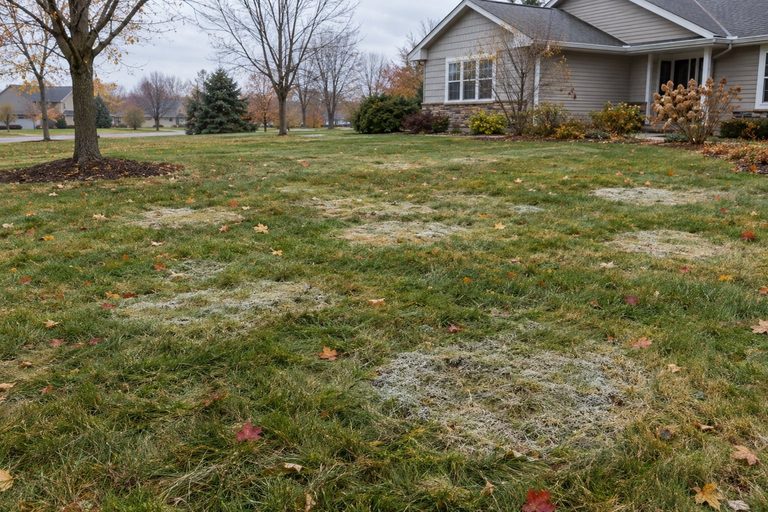
Why not leave it tall? Long grass going into winter lies over under the snow. That matted, wet layer is exactly where snow mold gets started. It's also good cover for voles, which tunnel under the snow and leave those winding trails across the lawn in March.
Why not scalp it? The crown of the grass plant, the growing point down at the soil line, is what has to survive the winter. Cut too low and you expose it to cold, wind and drying out. You also take away the leaf the plant is still using to make and store food for spring. A lawn scalped in November often greens up last and thinnest in April.
The last few cuts of the season are often more about leaves than grass, and that's a good use of the mower. Run over a light-to-moderate layer of leaves with a mulching mower and you chop them into pieces small enough to drop between the grass blades. They break down over the winter and feed the soil. A thick, wet blanket of whole leaves left on the lawn all winter will smother the grass underneath, so don't let them pile up.
If the leaves are so deep that you can't see grass after one pass, bag some and mulch the rest.
The last mowing lines up with a few other jobs that matter just as much:
On a course we'd say the grass decides when the season ends, not the calendar and not the neighbors. If yours is still growing in mid-November, keep cutting it at 2½ to 3 inches. If it quit in October, put the mower away and don't feel bad about it.
Get the last cut right and the lawn goes to sleep at a clean, healthy height, sheds the snow, and comes back strong in spring.
Purdue Extension, Fertilizing Established Cool-Season Lawns (AY-22); Purdue Extension, Lawn Improvement Programs (AY-13).
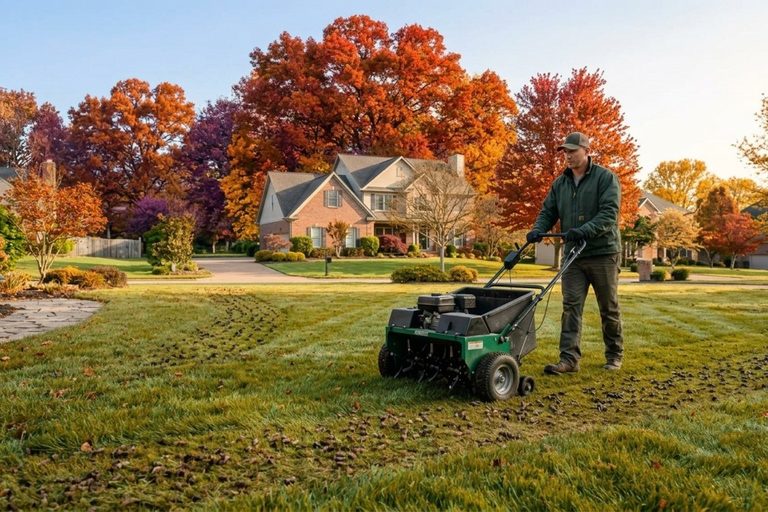
Photo: Man mowing the lawn in a suburban garden by Shixart1985, CC BY 2.0.
Snow mold hit many Minnesota lawns last spring. Learn the fall changes that reduce it: final mowing height, leaf handling, and fertilizer timing.
Late October core aeration can work if the grass is still growing and the soil is moist and unfrozen. Here's how to check, and when to wait.
Move carved pumpkins off the turf within days to compost, a drop-off, or a garden bed so the grass doesn't die underneath. Local rules vary.