Mowers & Equipment
Are Robot Mowers Good Enough Yet? A Golf Course Superintendent Judges the Cut
A golf course superintendent's verdict on robot mowers: why the cut beats rotary mowers, where they fall short, costs, and who should buy one.
Battery, gas or backpack: how to size a leaf blower to your yard, which specs count, what the noise does to your ears, and where gas blowers are banned.
Jack · golf course superintendent·8 min read·October 6, 2026
For most homes in the northern US, buy a battery handheld blower if you have a quarter acre or less and a couple of trees. If you have half an acre or more under big maples and oaks, buy a backpack, battery or gas. Before you buy anything that runs on gas, check your town's rules, because a growing list of cities ban gas blowers outright. Shop on blowing force (newtons) or air volume (CFM), weight, run time and noise, not on the big MPH number printed on the box.
The rest of this post covers how a grounds crew sorts that out, and how you can too.
In spring a blower cleans up grass clippings off the cart path. In October and November it moves tons of leaves before they mat down. Wet leaves left on turf under the first snow are a big part of how snow mold gets started, so on a golf course, getting leaves off the playing surfaces before the snow comes is part of the regular winter prep.
At home you often don't have to move every leaf to the curb. A light layer can be mulched into the lawn with the mower. The blower's job is the heavy stuff: beds, the driveway, fence lines, and the drift that piles up against the house.
Battery handheld. Light, quiet, starts every time. Consumer Reports found handheld cordless models average about 8 pounds and about 17 minutes of run time per charge, with the best ones going past 30 minutes. That's enough for a small lot, a patio, a driveway. It's not enough for an acre of oak leaves on one battery.
Battery backpack. The battery rides on your back, so you can carry a bigger one. Consumer Reports measured backpack run times of roughly 20 to 50 minutes, and one model ran 85. The ones it rated well sold for about $500 to $630 (as of October 2026). This is the right buy for most half-acre to one-acre yards with mature trees, especially if you already own the same brand's mower or trimmer and can share batteries.
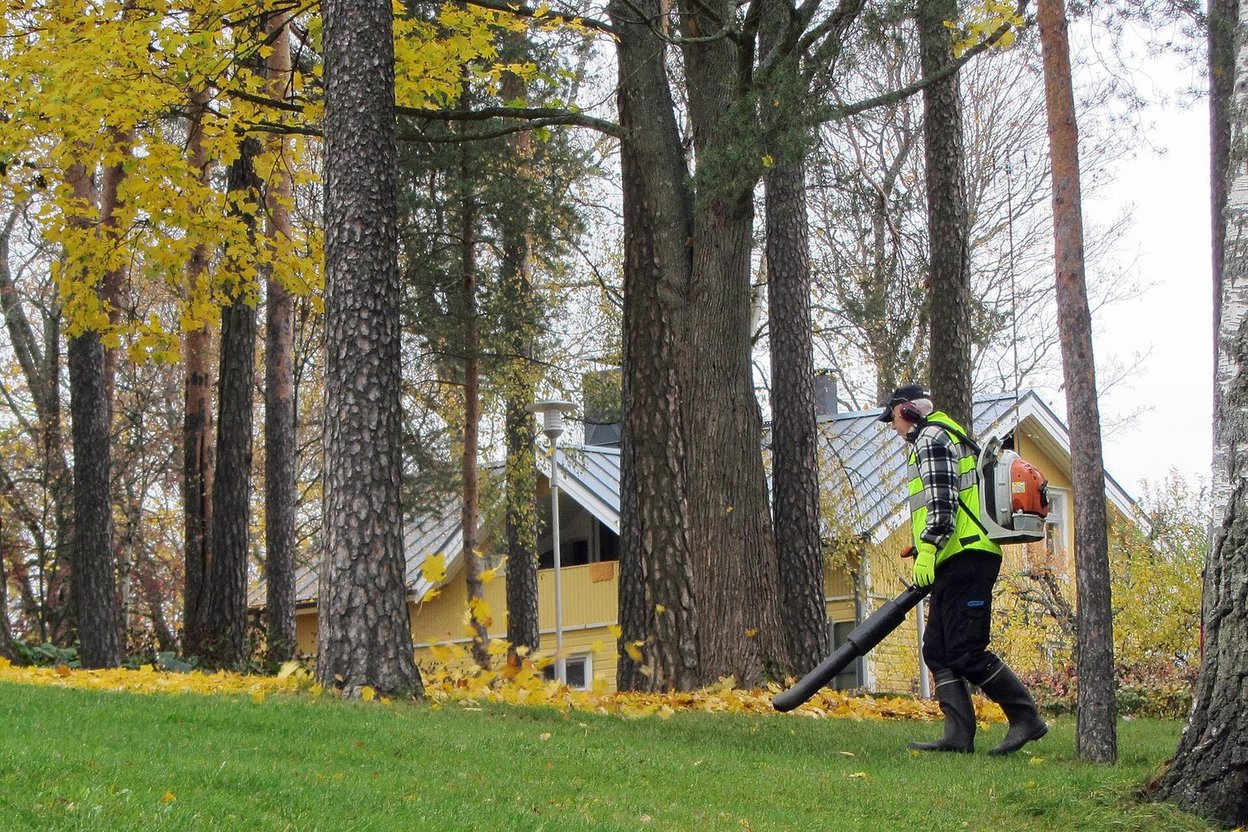
Gas backpack. Still the crew standard for big, wet, all-day jobs. A pro unit like the Echo PB-9010T is rated at 1,110 CFM and 220 mph. The Stihl BR 800 C-E is rated at 912 CFM and 239 mph. Both list around $700 (as of October 2026). You get unlimited run time, since refilling takes a minute, and you get the power to move wet, matted leaves. You also get the noise, the fumes, a two-stroke fuel mix, and in some places, a fine.
A quick way to decide:
CFM is how much air comes out. MPH is how fast it leaves the nozzle. A blower with huge MPH and little CFM throws a narrow jet that lifts a leaf and then drops it. For pushing a windrow of leaves across a lawn, volume does the work. For prying wet leaves out of a bed or a crack in the concrete, speed helps. You want a blower that's decent on both.
Some makers now list blowing force in newtons, which combines the two. Echo lists 48 N for the PB-9010T and Stihl lists 41 N for the BR 800 C-E. When two blowers both list it, that's the fairest comparison.
Watch out for battery blowers that only hit their rated CFM in "turbo" or "boost" mode. Boost drains the battery fast. Look at the run time on the normal setting, because that's the speed you'll use most.
Weight and harness. A 10-pound handheld feels light in the store and heavy after 40 minutes. On a backpack, check that the hip belt and shoulder straps adjust to fit you, and that the throttle is mounted on the tube so your hand isn't twisted. If the store will let you, try it on.
Fuel and storage. Gas blowers are two-stroke, so you mix oil into the gas. They gum up the same way a mower does if you leave ethanol fuel in them over winter. Read up on stabilizer and ethanol before you buy cans of fuel. Battery blowers have their own winter routine: store the battery indoors, part charged, not in a freezing garage.
Blower noise ratings are usually measured 50 feet away. A blower rated 70 to 75 dB at 50 feet can be 90 to 100 dB at the operator's ear. A study of groundskeepers at North Carolina public universities measured leaf blower noise averaging 89 dBA, peaking at 106, both over the NIOSH recommended limit of 85 dBA.
That's why crews wear hearing protection with every blower, battery ones included. Foam plugs or muffs cut 15 to 30 dB if they fit and you wear them right. Plugs cost a few dollars a box. Put them on before you pull the cord.
Battery blowers are noticeably quieter, and they're quiet where it counts, at the property line. Your neighbor at 7 a.m. on a Saturday will notice the difference before you do.
This has moved fast. These are a few real examples, not a full list:
Plenty of towns in New York, New Jersey, Massachusetts and the Chicago suburbs only allow gas blowers in spring and fall, or set hours. Those rules are written town by town, so check your city or village code before you spend $700 on a gas backpack. Check your state's rules too.
A bigger blower won't fix bad technique. A few habits that save time:
Photo: Leaf blower in Kerava - Lehtipuhallin, Lövblåsare C IMG 1120 by Anneli Salo, CC BY-SA 4.0.
A golf course superintendent's verdict on robot mowers: why the cut beats rotary mowers, where they fall short, costs, and who should buy one.
A small lawn under 5,000 square feet needs a basic mower, not a $6,000 one. Learn the cut height, blade, and upkeep that actually matter.
Battery or gas mower in snow country: how cold affects each one, the right fall mowing height, and how to store each over winter.