Fall & Winter
Snow mold on Minnesota lawns last spring: what to change this fall
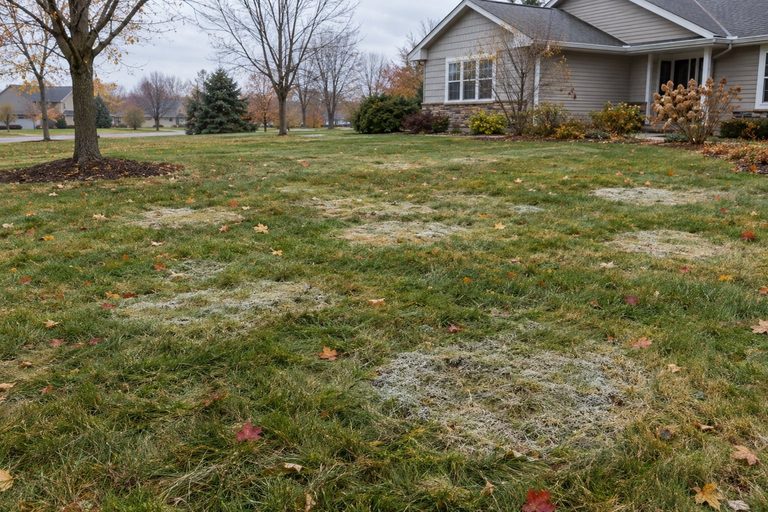
Snow mold hit many Minnesota lawns last spring. Learn the fall changes that reduce it: final mowing height, leaf handling, and fertilizer timing.

The most useful fertilizer feeding of the year for northern lawns comes after the last mowing. When to apply it, how much nitrogen, what product, and the mistakes to avoid.
Jack · golf course superintendent·4 min read·October 1, 2026
If I could only fertilize a cool-season lawn once a year, I wouldn't do it in spring. I'd do it in late fall, right around the last mowing. On the golf course this was one of the feedings we never skipped, and it's the one most homeowners have never heard of.
By November the grass has mostly stopped growing leaves. But it hasn't stopped working. The roots keep growing as long as the soil isn't frozen, and the plant is still making food in its green leaves on mild days. Nitrogen you put down now doesn't go into a flush of top growth you have to mow. The plant stores it.
That stored food pays off three ways:
This applies to cool-season grasses: Kentucky bluegrass, tall fescue, perennial ryegrass and the fine fescues. If your lawn goes brown and dormant in winter, this is your feeding.
The target is after the last mowing of the year, while the grass is still green. Purdue University's turf program puts this application around or just after the final mowing, and lists September and November as the two best times to fertilize a cool-season lawn.
In practice, that's somewhere between late October and late November across most of the northern US, earlier in the far north and in the mountains, later near the coasts and the big lakes. Watch the grass, not the calendar. If it's still green and the ground isn't frozen, you're in the window.
Don't apply it to frozen ground or right before a heavy rain. Fertilizer on frozen soil can wash off into the street and the storm drain instead of into the root zone.
Purdue's guidance for the late-fall application is 1.0 to 1.25 pounds of actual nitrogen per 1,000 square feet.
To turn that into product, divide by the first number on the bag. A 46-0-0 urea is 46% nitrogen, so about 2.2 pounds of product puts down 1 pound of nitrogen per 1,000 square feet. A 32-0-4 product would take a little over 3 pounds per 1,000 square feet. Measure your lawn once, write the square footage on the garage wall, and you'll never guess again.
For this feeding, a quick-release (soluble) nitrogen like urea works well, because the grass needs to take it up while it's still active. Slow-release products are great in spring and early fall, but much of their nitrogen may not be released until the soil warms up next year.
Skip the phosphorus unless a soil test says you need it. Many states and towns restrict phosphorus on established lawns because it washes into lakes and streams. Most lawn fertilizers sold today already show a zero in the middle. If you haven't had a soil test in a few years, fall is a great time to do one; see our guide to reading a soil test report.
If you want the whole year mapped out, our guide to building a professional-grade fertility program lays out every application. But if you only add one thing this year, make it this one.
Snow mold hit many Minnesota lawns last spring. Learn the fall changes that reduce it: final mowing height, leaf handling, and fertilizer timing.
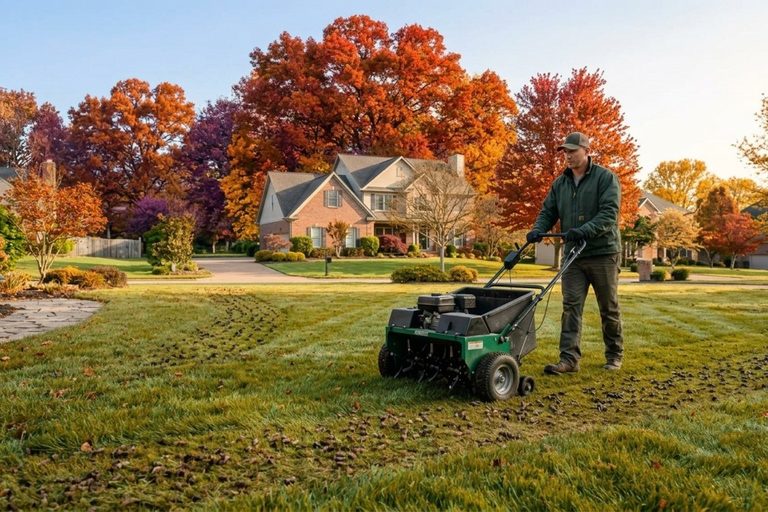
Late October core aeration can work if the grass is still growing and the soil is moist and unfrozen. Here's how to check, and when to wait.
Move carved pumpkins off the turf within days to compost, a drop-off, or a garden bed so the grass doesn't die underneath. Local rules vary.