Trees & Shrubs
Salt-Tolerant Shrubs and Grasses for Curb Strips and Driveways
Which shrubs, ornamental grasses and lawn grasses actually survive road salt along curbs and driveways, which to avoid, and how to plant them.
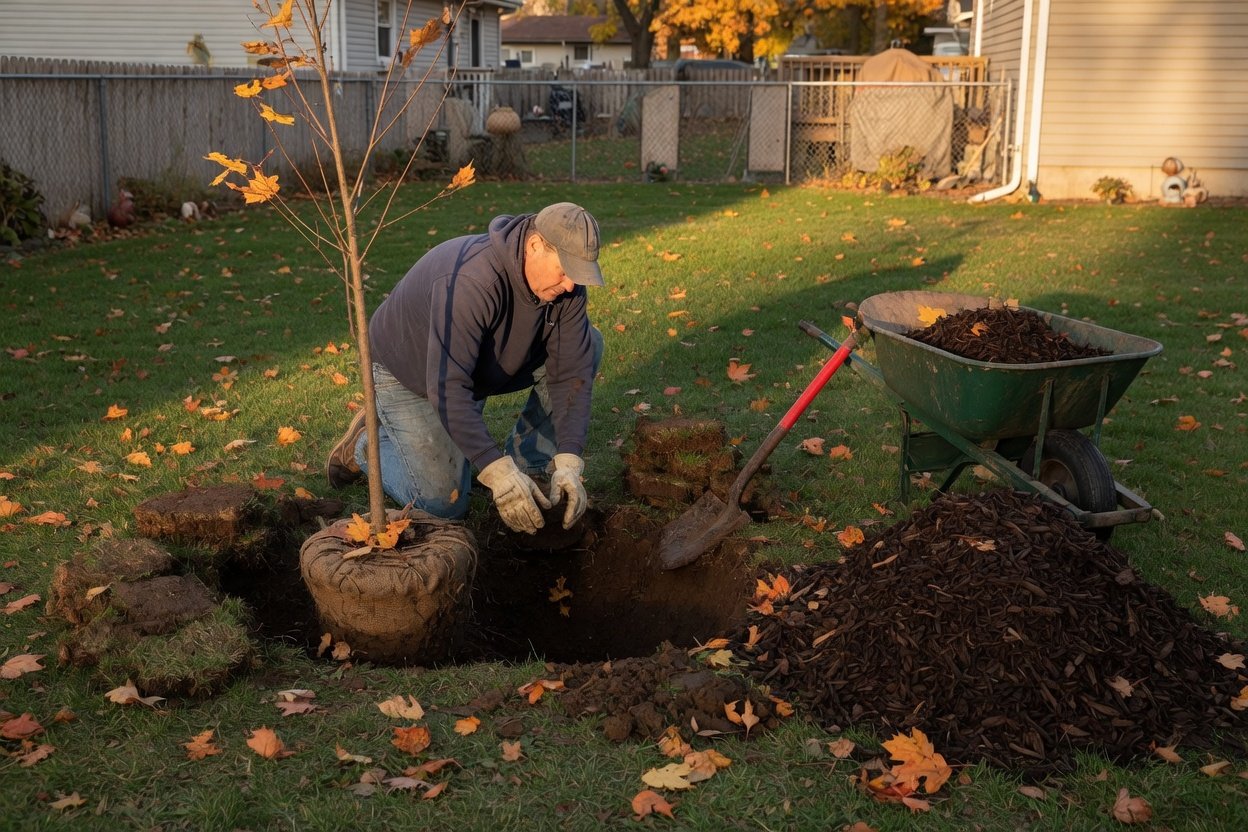
Fall is one of the best times to plant a tree up north: warm soil, cool air, and fall rain. When to plant, the trees that do better in spring, how deep, and how to water it into winter.
Jack · golf course superintendent·4 min read·October 3, 2026
There's an old saying in the nursery business: fall is for planting. Across the northern US that's mostly true. The air is cool, so the tree isn't losing much water through its leaves, but the soil is still warm, so roots keep growing for weeks after the top goes dormant. A tree planted in early fall often has a head start on one planted the following spring.
Plant from about the time the leaves start to change until roughly six weeks before the ground freezes. In most of the northern U.S. that's September through October, earlier up north and in the mountains. Roots keep growing as long as the soil stays above about 40°F, and planting early in that window gives them the most time.
If you miss the window, the tree can still go in, but it has less time to root and needs more help over winter.
Some trees are slow to root and more likely to struggle if planted in fall. Extension services often list:
They can be planted in fall, but spring is safer. Most maples, lindens, spruces, pines, and crabapples handle fall planting well. Ask your nursery; they'll know what does well in your area.
Don't fertilize at planting. The tree needs roots, not a push of new growth.
Most trees don't need stakes. If yours is tall, top-heavy, or on a windy site, stake it loosely with wide straps so the trunk can still move a little (movement builds a stronger trunk). Remove stakes after one growing season.
This is the step that decides whether a fall-planted tree makes it. Water deeply once a week, unless it rains about an inch, right up until the ground freezes. A slow soak at the base with a hose is better than a quick spray. See water your trees before the ground freezes.
A newly planted tree is the most likely to get sunscald and rodent damage. Put on a trunk guard and a hardware-cloth collar after the leaves drop. See wrapping young trees.
Don't panic if the tree leafs out a little late or looks thin in its first year. It's putting energy into roots. Keep watering through its first couple of summers, and it'll take off by year three.
Which shrubs, ornamental grasses and lawn grasses actually survive road salt along curbs and driveways, which to avoid, and how to plant them.
How to decide whether to treat or remove your ash tree for emerald ash borer: the canopy rule, size limits, timing, and what each choice costs.
Heavy wet snow splits arborvitae and flattens yews. How to tie them up before winter, how to clear snow safely, why you should never whack an iced branch, and how to fix…