Trees & Shrubs
Salt-Tolerant Shrubs and Grasses for Curb Strips and Driveways
Which shrubs, ornamental grasses and lawn grasses actually survive road salt along curbs and driveways, which to avoid, and how to plant them.
How to decide whether to treat or remove your ash tree for emerald ash borer: the canopy rule, size limits, timing, and what each choice costs.
Jack · golf course superintendent·7 min read·October 6, 2026
Treat your ash if it's healthy or has lost less than half its canopy, it's in a spot where you want a big shade tree, and you're willing to keep treating it for as long as you own it. Remove it if more than half the crown is thin or dead, if it has trunk or structural damage, or if it's a tree you wouldn't miss. University extension guidance draws the line at 50% canopy thinning. Above that, insecticides rarely bring the tree back.
On a golf course we sorted our ash the same way: keep the ones that frame a hole or shade a tee, and take out the rest before they died and turned into a liability. You can do the same in your yard.
Emerald ash borer only attacks true ash (Fraxinus). Mountain ash isn't a true ash and isn't affected. Ash leaves are compound with 5 to 11 leaflets, and they grow opposite each other on the twig. Mature trees have tight, diamond-patterned bark.
Look for at least two of these, because any single symptom can come from another pest or stress:
The beetle is now in dozens of states, from the East Coast across the Midwest to Colorado's Front Range and western Oregon. If your county has confirmed EAB, assume your untreated ash will get it.
Stand back far enough to see the whole crown and compare it with a healthy ash, or with what the tree looked like a few years ago. Picture the crown in quarters. If two of those quarters are bare or full of thin, tufted leaves only at the branch ends, you're at 50% and the tree is a removal.
Ash is one of the first trees to drop its leaves in fall, so in October you may be looking at bare branches. If you can't tell, mark your calendar for June, when the tree is fully leafed out. That's also right in the best treatment window, so you lose nothing by waiting.
Trees under about 30% dieback are the strongest treatment candidates. Between 30% and 50% it's a judgment call, and treatment works best on trees that are still growing well.
Every systemic treatment has to be repeated for as long as you want to keep the tree. You're not curing it, you're keeping it protected.
Emamectin benzoate trunk injection (arborist only). This one has the best research behind it. In trials, a single injection gave close to complete larval control for 2 to 3 years, so most arborists treat every other year. The best time is after the tree leafs out in spring, roughly mid-May to mid-June. Your arborist drills small holes around the base of the trunk and injects through them.
Imidacloprid soil drench (homeowner products). This is what you'll find at the hardware store, under labels like BioAdvanced 12 Month, Bonide Annual and Ferti-lome. You mix it with water and pour it around the base of the trunk. It has to be done every year, and spring works best. Wisconsin Extension recommends mid-April to mid-May. A fall drench can work, but research shows it takes higher rates to get the same control, and you can't go over the rate on the label.
The size limit matters. Homeowner drenches work on trees under about 15 inches in diameter, which is about 47 inches around at chest height. On bigger trees they don't deliver enough insecticide, and labels cap how much you can legally apply per acre per year. If your tree is bigger than that, hire an arborist.
To measure: wrap a tape around the trunk 4.5 feet off the ground and divide by 3.14. A 63-inch circumference is a 20-inch tree, which is arborist territory.
Check your state's rules too. A few states restrict certain products or require a licensed applicator for some methods.
These are rough figures as of October 2026. Get local quotes.
The last number is the one that catches people. Dead ash goes brittle fast. Climbers won't go up a tree they don't trust, so the crew brings in a bucket truck or crane. And a brittle limb over your roof, driveway or the kids' swing set is a hazard every windy day until it's down.
Run the numbers for your own tree. A healthy 20-inch ash shading the south side of your house costs about $2,400 to treat over 20 years. Removing it, grinding the stump and replanting can cost close to that up front, and you'd wait 20 years or more for that much shade again. For a tree like that, treating is the better deal. For a scraggly ash in the back corner, it isn't.
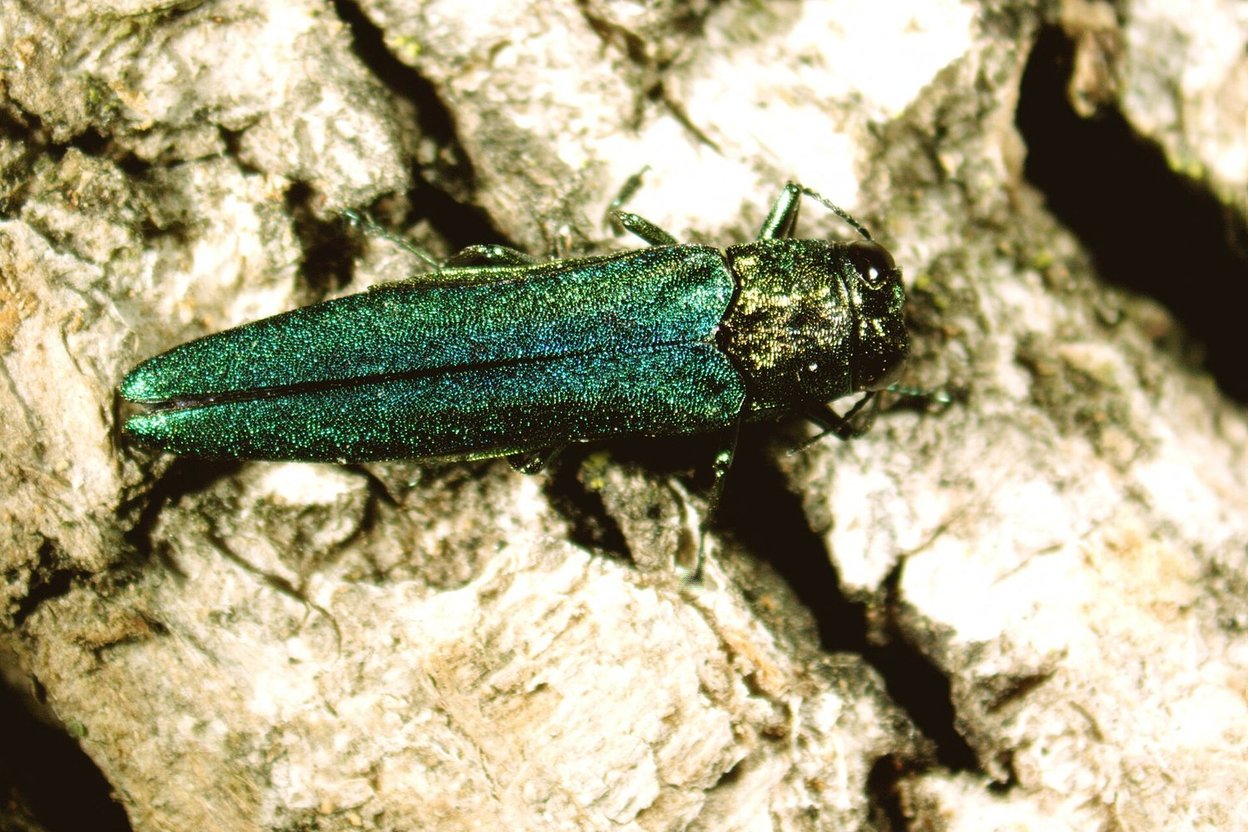
Photo: Plant Protection and Quarantine (34954841290).jpg) by APHIS.gov, Public domain.
Which shrubs, ornamental grasses and lawn grasses actually survive road salt along curbs and driveways, which to avoid, and how to plant them.
Heavy wet snow splits arborvitae and flattens yews. How to tie them up before winter, how to clear snow safely, why you should never whack an iced branch, and how to fix…
When the snow comes, deer go after arborvitae, yews and young trees. Which plants they love, the fences and wraps that actually stop them, repellents, and when to put protection up.