Lawn
How to Fix Fertilizer Stripes in Your Lawn (and Never Get Them Again)
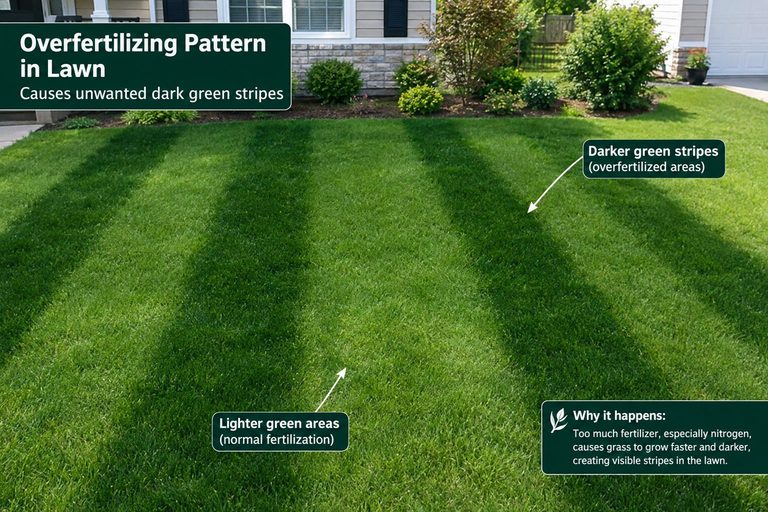
Tell dark-green overlap stripes from yellow burn stripes, fix each one, and calibrate your spreader and walking pattern so they don't come back.
Most lawns need two or three feedings a year, plus crabgrass prevention only if needed. A golf course superintendent's yearly schedule.
Jack · golf course superintendent·9 min read·October 13, 2026
It's fall, and a lawn company's flyer is on your door again, selling next year's program: round after round of "treatments" from spring thaw to Thanksgiving. Here's the real answer. Most cool-season lawns need two or three fertilizer feedings a year, weighted to fall. Add one crabgrass preventer in spring, but only if crabgrass is actually a problem in your yard. Everything else is "only if a problem shows up," and you find that out by looking at the lawn, not by checking a calendar.
I spent more than 20 years as a golf course superintendent. Our fertility program wasn't built around how many times a truck could come through the gate. It was built around what the grass needed and when it could use it. A home lawn of bluegrass, fescue or ryegrass works the same way.
In neighborhoods, I see homeowners signing up for six applications in a short northern growing season. If the first two rounds got the weeds under control, they don't need the company spraying again. Too much fertilizer also makes grass grow too fast, which just means more mowing. A salesman sells the biggest package he can. For a typical yard, feeding once or twice a year does the job. It's just grass.
Here's a sample year at a glance:
That's two to four applications in most years, not six or seven.
If you fertilize only once a year, do it in fall. University of Minnesota turf specialists name early August through mid-October as the best time to fertilize home lawns. University of Missouri Extension calls September "the most important time to fertilize." Cool-season grass is building roots and storing energy then, not pushing out top growth you have to mow.
Minnesota suggests putting about one-third of your yearly nitrogen down in spring and two-thirds in fall. Each feeding should be about 0.75 to 1 pound of actual nitrogen per 1,000 square feet. Penn State says to keep home lawns at or below 1 pound per application, in two or three applications a season. Minnesota says a grade close to 24-0-12 suits most lawns. At that grade, about 4 pounds of product per 1,000 square feet puts down 1 pound of nitrogen.
The yearly total depends on your grass. Missouri's guidelines, in pounds of nitrogen per 1,000 square feet per year:
Penn State gives 2 to 3.5 for Kentucky bluegrass. These numbers shift from region to region, so check your own state extension office.
Missouri's program calls for 1 to 1.5 pounds in September and a second feeding in mid-October. A spring feeding is optional, and two or three fall feedings may make it unnecessary. Spring nitrogen has a real cost, too. Missouri warns that spring and summer nitrogen, especially the quick-release kind, encourages disease. A lawn that's already growing well can turn lush and disease-prone if you feed it in spring. If you're reading this in early October, the second fall feeding is still ahead of you.
Crabgrass is the one weed worth a calendar treatment, and only in lawns that actually get it. North Dakota State University says crabgrass starts germinating once the average soil temperature 2 inches down holds at 55°F for three to five days, and most of it comes up at 60 to 70°F. Get the preventer down before the soil reaches 55°F, then water it in with about half an inch of water.
Go by soil temperature, not a date. Missouri's calendar says to apply by April 15, but that's a Missouri date. Further north, the soil warms later. A cheap soil thermometer pushed 2 inches into the ground will tell you more than any date on a flyer.
There are two exceptions:
If your lawn is thick and you had no crabgrass last summer, skip this one entirely. On the course, the best weed control we had was dense turf. Missouri says the same thing: a dense, healthy lawn is the best weed control, and herbicide shouldn't be your only tool.
Fall is the best time to go after dandelions, clover and other broadleaf weeds. Missouri names late September as the best time for broadleaf herbicides, especially for perennial weeds. NDSU explains why: in fall, weeds are moving nutrients down into their roots, and they carry the herbicide down with them.
Spray only where the weeds are. If you've got a dozen dandelions, you don't need to treat 8,000 square feet of grass to kill them. Get a pump sprayer, walk the yard and hit the patches. Skip the hose-end weed-and-feed bottle over the whole lawn.
Both the University of Minnesota and NDSU advise against weed-and-feed. NDSU says it works less well, adds herbicide runoff, and gets tracked into the house. It also forces bad timing: the best time to feed and the best time to kill a given weed are rarely the same day. And the herbicide goes on every square foot, weeds or not.
Minnesota adds that many annual weeds die off on their own. Summer annuals like crabgrass are handled with the spring preventer, not with a summer spraying program.
Grub control is the treatment most often sold "just in case," and it's the easiest to check for yourself. Cut a one-square-foot section of turf on three sides, peel it back and count the grubs. Illinois Extension says to check several spots. Both Illinois Extension and the Chicago Botanic Garden put the treatment threshold at about 10 grubs per square foot. Below that, a healthy lawn tolerates the feeding.
Before you blame grubs for brown patches, rule out the look-alikes. Illinois Extension notes that drought, compaction and disease can all look like grub damage. If the turf doesn't peel up like a loose carpet, grubs probably aren't the problem.
Timing matters more than the product. Treatments work best on young grubs that are actively feeding. In northern Illinois, for example, beetles lay eggs from June into early July. Illinois Extension times preventive imidacloprid for around late July on irrigated lawns where adult beetles are active, and the Chicago Botanic Garden suggests mid-July. Timing varies by region, so check with your local extension office. Use a preventive only if you've had real grub damage before.
If you find grubs now, in fall, treat only the problem spots. As the weather cools, grubs move deeper into the soil, where most products can't reach them. Fall treatment is late. Plan for next summer instead.
The cheapest application is the one the lawn doesn't need. Three habits get you there:
A simple yearly program:
When the lawn-service salesperson comes by, tell them what you want: two fall feedings, a spring preventer if needed, and spot treatment of weeds and grubs only when they find them. Ask them to show you the grubs before they treat. A good company will work with that. If they won't, you just learned what you were paying for.
Tell dark-green overlap stripes from yellow burn stripes, fix each one, and calibrate your spreader and walking pattern so they don't come back.
Skip the flyer: a screwdriver probe and thatch check show whether your lawn needs aeration, plus soil and traffic guidance on when to core aerate.
How many times a year a home lawn really needs fertilizer: usually one or two feedings, with timing, pounds of nitrogen, and when to skip.