Lawn
How Many Lawn Treatments Do You Really Need? A Golf Course Superintendent's Answer
Most lawns need two or three feedings a year, plus crabgrass prevention only if needed. A golf course superintendent's yearly schedule.
Tell dark-green overlap stripes from yellow burn stripes, fix each one, and calibrate your spreader and walking pattern so they don't come back.
Jack · golf course superintendent·9 min read·October 16, 2026
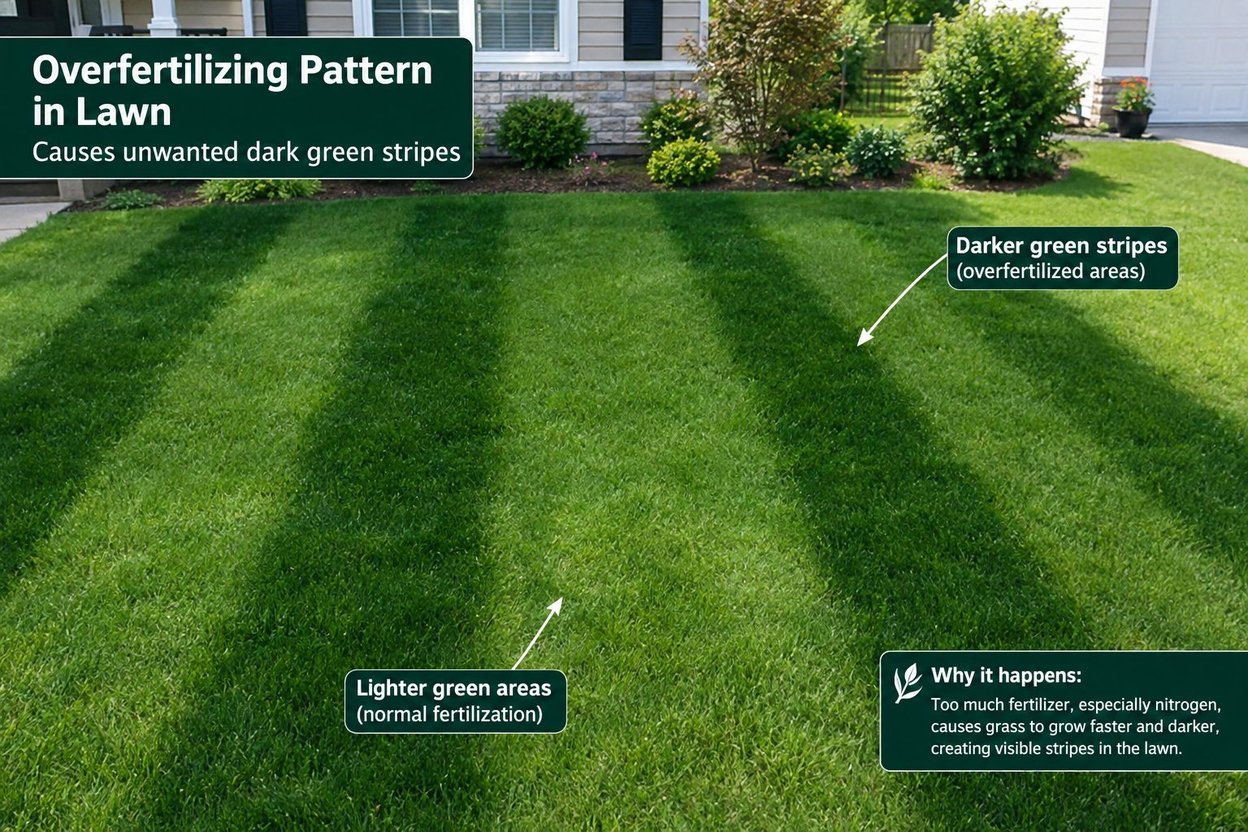
You fertilized last weekend, and now the lawn looks like a bar code. The stripes run in straight lines that match your spreader passes. First figure out what color they are. If they're dark green, you overlapped. The extra nitrogen will run out and the stripes will fade on their own. If they're yellow, brown or straw-colored, that's salt burn. Act now: sweep up loose granules, soak the area, and keep watering it for a week. Then set up your spreader and your walking pattern so it doesn't happen again.
Stripes after fertilizing are a known problem with a known cause. UC IPM describes "stripes of green, white, or brown turf" that follow the pattern of the application and show up soon after you fertilize. The color tells you which problem you have.
Dark green stripes next to lighter ones. This one isn't damage. It's uneven coverage. The strips that got fertilizer, or got it twice, turn rich green. The strips you missed stay pale. In 20-some years running golf courses, I've seen this "zebra lawn" on fairways and in plenty of neighborhoods. There's nothing to repair. The extra nitrogen gets used up and the color evens out. Your job is to fix the spreader and the pattern before the next application.
Yellow, brown or straw-colored stripes. This is fertilizer burn. Washington State University explains that too much fertilizer raises the salt level in the soil. The salt damages roots and makes it harder for them to take up water. Nevada Extension notes that the yellow-to-brown color usually appears a day or two after fertilizing. Their fix: sweep up what you can, soak the area until the soil underneath is saturated, then give it about an inch of water a day for seven days. With that much water, they say the grass should start regrowing in about 7 to 14 days. If it doesn't come back, it's dead, and you reseed or sod.
Both kinds of stripe come from the same few mistakes.
The color tells you what happened. The list above tells you what to change.
A note on fall damage: if you burned a stripe with a late-season feeding, the grass may go dormant before you can tell what lived and what died. Up north, a stripe from mid-October often doesn't show its final answer until spring green-up. Flush it with water now anyway. Then wait until spring to decide whether it needs seed.
The setting chart on the bag is a starting point, not the answer. UF/IFAS says to calibrate separately for each material and each operator. The University of Georgia explains why: every product has its own distribution pattern, and the rate also changes with the product's weight and density, the wind, temperature, humidity, and how fast you walk.
The weigh-and-measure method UF/IFAS describes works like this:
Here's a worked example using UF/IFAS numbers. A 20-0-10 fertilizer is 20 percent nitrogen. To put down 1 pound of nitrogen per 1,000 square feet, you need 5 pounds of product per 1,000 square feet (1 divided by 0.20). For a drop spreader on a 100-square-foot test strip, that's half a pound. Say you load 10 pounds into the rotary, walk the 1,000-square-foot area, and have 7 pounds left. You put down 3 pounds when you needed 5, so open the setting and try again.
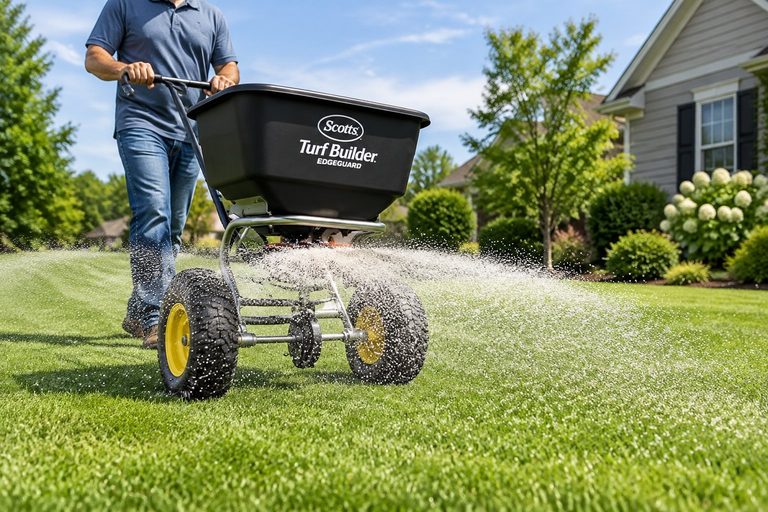
Drop or rotary? UF/IFAS explains the tradeoff. A drop spreader only covers the space between its wheels, with a hard edge on each side. Your passes have to meet exactly or you'll see skips. It's the zebra-lawn machine if you're careless. A rotary throws a wider pattern that tapers off at the edges. That's more forgiving of skips, but it's harder to calibrate. UF/IFAS also notes that a drop spreader's agitator can break the coating on coated slow-release products, so use soluble or reacted slow-release products in a drop spreader.
When I've seen a zebra lawn, the fix was always the same three things: the spreader setting, the overlap pattern, and walking speed. A calibrated spreader takes care of the first. Here's how to handle the other two.
If you get a late-fall feeding down before Thanksgiving, this is the time to run it this way: calibrate on the driveway, make your edge passes, then cross-hatch the middle. It adds about ten minutes and saves you from having to fix stripes next spring.
Most lawns need two or three feedings a year, plus crabgrass prevention only if needed. A golf course superintendent's yearly schedule.
Skip the flyer: a screwdriver probe and thatch check show whether your lawn needs aeration, plus soil and traffic guidance on when to core aerate.
How many times a year a home lawn really needs fertilizer: usually one or two feedings, with timing, pounds of nitrogen, and when to skip.