Lawn
How to Fix Fertilizer Stripes in Your Lawn (and Never Get Them Again)
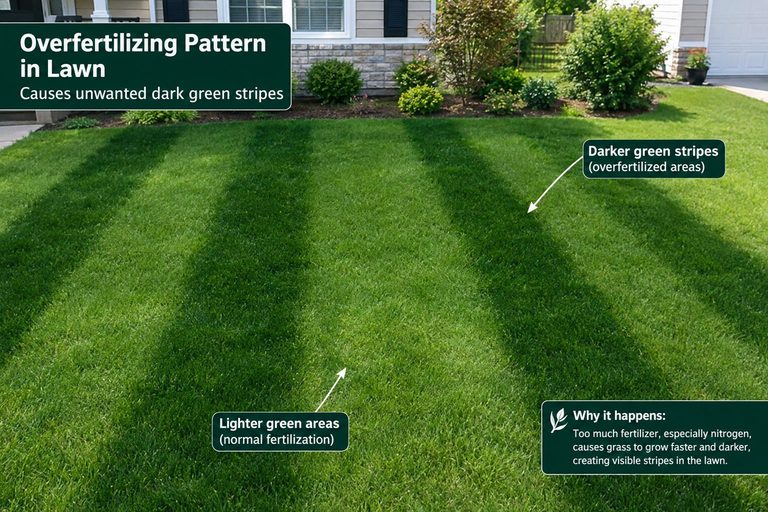
Tell dark-green overlap stripes from yellow burn stripes, fix each one, and calibrate your spreader and walking pattern so they don't come back.
Skip the flyer: a screwdriver probe and thatch check show whether your lawn needs aeration, plus soil and traffic guidance on when to core aerate.
Jack · golf course superintendent·9 min read·October 12, 2026
The flyer is stuck in your storm door again: "Fall aeration special, book now." Maybe the spring one came too. So should you aerate your lawn every year? Probably not. Whether your lawn needs it depends on your soil and how much traffic it gets, and you can check both in about ten minutes with a screwdriver and a pocketknife. Golf courses aerate on a calendar because they're under pressures your yard never sees. Your lawn should be aerated when it gives you a reason.
You don't necessarily need to aerate every year. The university extension services don't agree with each other on this, and you should know that before anyone sells you a program.
Iowa State takes the most aggressive line. Lawns on heavy clay or with heavy foot or pet traffic get aerated twice a year, and lawns on well-drained soil with little traffic get it once a year. North Dakota State says about once every 1 to 5 years, more often for heavy soils or heavy foot traffic. NDSU also says most lawns don't need aeration, even though almost all lawns benefit from it. Clemson says "as often as needed." That can mean once every couple of years or several times a season, depending on soil and traffic.
Here's how I read that. For clay soil or a busy yard, I treat aeration once a year as the starting point. For everyone else, I aerate when the lawn fails a test, not when the calendar says so. "Benefits from it" and "needs it" are two different things, and only one of them is worth paying for every fall.
Homeowners get sold aeration in spring and again in fall, and a lot of that idea comes from golf. On the course we needed it. Thousands of golfers, golf carts and mower trips compact the soil, and that doesn't let up all season.
Golf turf is aerated for four main reasons:
That last reason carries a lot of weight on a course. The USGA has said that excess thatch on golf turf usually comes from too little core aeration or vertical mowing. Too much thatch makes greens and fairways soft and wet, slows green speed and makes pesticides work less well. Greens and fairways are managed to be firm and fast. A spongy surface is a problem for a golf course. In your backyard it's just grass.
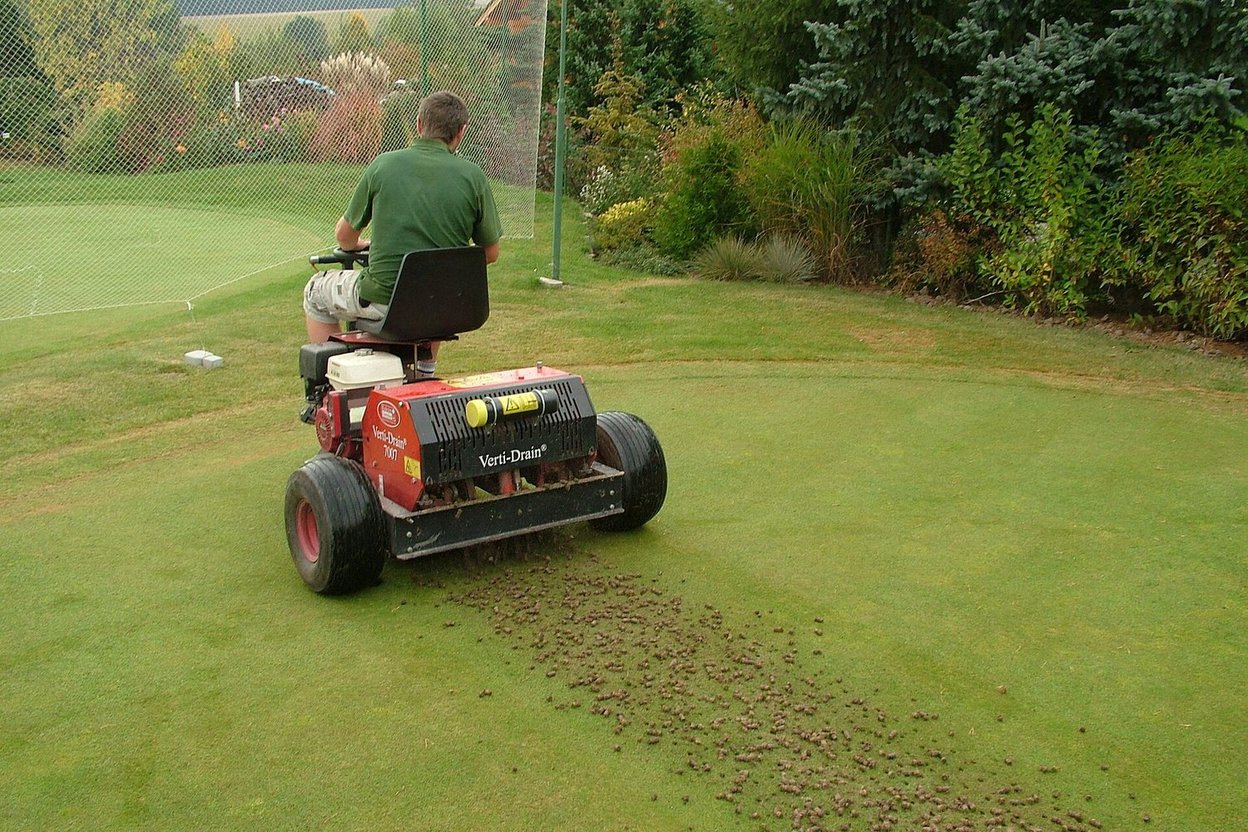
Then there's the part that never makes it into the sales pitch. On the course we pulled plugs and then topdressed with sand to fill the holes. Core aeration together with sand topdressing is considered the most effective way to control organic matter near the surface of sand-based greens. The aeration and the sand work as one program.
At home, your family isn't compacting the yard like that, and nobody fills the holes with sand. So you get only part of what the course gets out of aeration, and you may not have the problem it's meant to fix.
You can skip the guessing. These checks take a few minutes. Do them a day or two after a good rain, when the soil is moist.
The screwdriver probe. Push a long screwdriver into the lawn in several spots. Clemson says that if it's hard to push into moist soil, the lawn may need aeration. Compaction usually affects the top 4 to 6 inches, so you're feeling for resistance in that zone.
The concrete feel. Clemson describes compacted turf as feeling like "walking on concrete." If your grass feels hard underfoot when the ground isn't frozen or bone dry, pay attention.
Water behavior. Watch the lawn during a heavy rain or while the sprinkler runs. Look for water running off the lawn, water ponding on it, or soil that's hard to wet during a dry spell. All three are classic compaction signs.
Thin turf with shallow roots. Grass that thins out and wilts easily, with roots that stay near the surface, is often growing in soil that's too tight for roots to get through.
The thatch wedge. Cut a wedge of turf about 2 inches deep and measure the spongy brown layer between the green blades and the soil. NDSU says thatch becomes a problem at about 1 inch. You'll see lawn companies quote a lower number, often half an inch, so the threshold depends on whose advice you read. A thin layer is actually good: NDSU notes that it insulates the soil against temperature and moisture extremes. Compaction and thatch are linked, too. Clemson says compacted soil is low in oxygen, which hurts the earthworms and other organisms that break thatch down. That's why thatch builds up faster on compacted and heavy clay soils.
If the screwdriver goes in easily, water soaks in, the turf is thick and the thatch is under an inch, your lawn passed. Skip aeration this year.
Once you've run the test, your soil and how you use the yard set your schedule.
Aerate once or twice a year if you have:
NDSU lists lawns with heavy foot traffic, thatch over 1 inch and heavy soils as the ones that need aeration most. Iowa State's twice-a-year advice is aimed at heavy clay and heavy foot or pet traffic. On these lawns, aeration earns its money. Iowa State says it relieves compaction, improves water and nutrient movement and helps prevent thatch. Clemson adds better drainage, less runoff and better drought tolerance.
Aerate every few years, or only when the test says so, if you have:
You don't have to treat the whole yard the same way, either. A worn path to the back gate or a dog run along the fence may need aeration while the front lawn doesn't. Aerate the problem spots and leave the rest alone. A course crew works the same way: put the effort where the wear is, so the rest of the property doesn't eat up your weekends.
If your lawn fails the test, do the job properly once instead of halfway every year.
Use a core aerator. A core aerator is a hollow-tine machine that pulls plugs of soil out of the ground. Spike aerators, spiked rollers and spiked sandals don't do the job. Iowa State says spike-type tools just punch holes and can compact the soil further. NDSU also says to use a hollow-tine core aerator, not a solid-tine or spiking tool.
Pull the right plugs. Iowa State says to aim for cores about 3/4 inch across and 3 inches long, with 20 to 40 holes per square foot. That usually means several passes, so go over the lawn in more than one direction.
Time it for fall. Fall is the best season for cool-season lawns. Clemson points to less heat stress and less risk of weedy annuals moving in. NDSU says late August to mid-September is best. Iowa State names September and April as the best months. In much of the Midwest, that makes September the target. Clemson also says to allow at least four weeks of good growing weather afterward for recovery. If you're reading this in October in a colder spot, you may be too late for this year. Spring is the backup, and April works fine.
Moist soil, not wet. Aerate when the soil is moist. If it's dry, the tines can't go in. If it's wet, they clog.
Leave the cores. Don't rake them up. Clemson says the cores contain microorganisms that help break down thatch. NDSU says to let them dry for a couple of days, then mow over them to break them up.
Follow with seed and fertilizer. Iowa State suggests fertilizing a week before aerating. Both Iowa State and NDSU say you can overseed and fertilize right after. If the weather turns dry, water afterward. The holes give seed and fertilizer an easy way into the soil, which is the main thing a homeowner gets out of aeration without a load of sand behind it.
Before you book anything this fall, do the screwdriver test and cut a thatch wedge. If your lawn passes, skip aeration and spend that money on fall overseeding and fertilizer, which do more for a thin cool-season lawn than holes alone. If it fails because of clay, kids, dogs or an inch of thatch, core aerate in September, leave the cores, seed and feed. Then test again next year. Aerate when there's a reason, real compaction, not because a flyer showed up in your storm door.
Photo: 091008 ATRGC Aerifikace greenu 0024 by Vít Švajcr Dobré světlo.com, CC BY-SA 3.0.
Tell dark-green overlap stripes from yellow burn stripes, fix each one, and calibrate your spreader and walking pattern so they don't come back.
Most lawns need two or three feedings a year, plus crabgrass prevention only if needed. A golf course superintendent's yearly schedule.
How many times a year a home lawn really needs fertilizer: usually one or two feedings, with timing, pounds of nitrogen, and when to skip.