Golf Course Know-How
The Golf Course Trick That Cut Out Our Trimming: Tree Rings, Fence Lines, Pavement
Learn how golf courses kill grass at trees, fences and pavement to end string trimming. Covers mulch rings, edge strips and safe spraying.
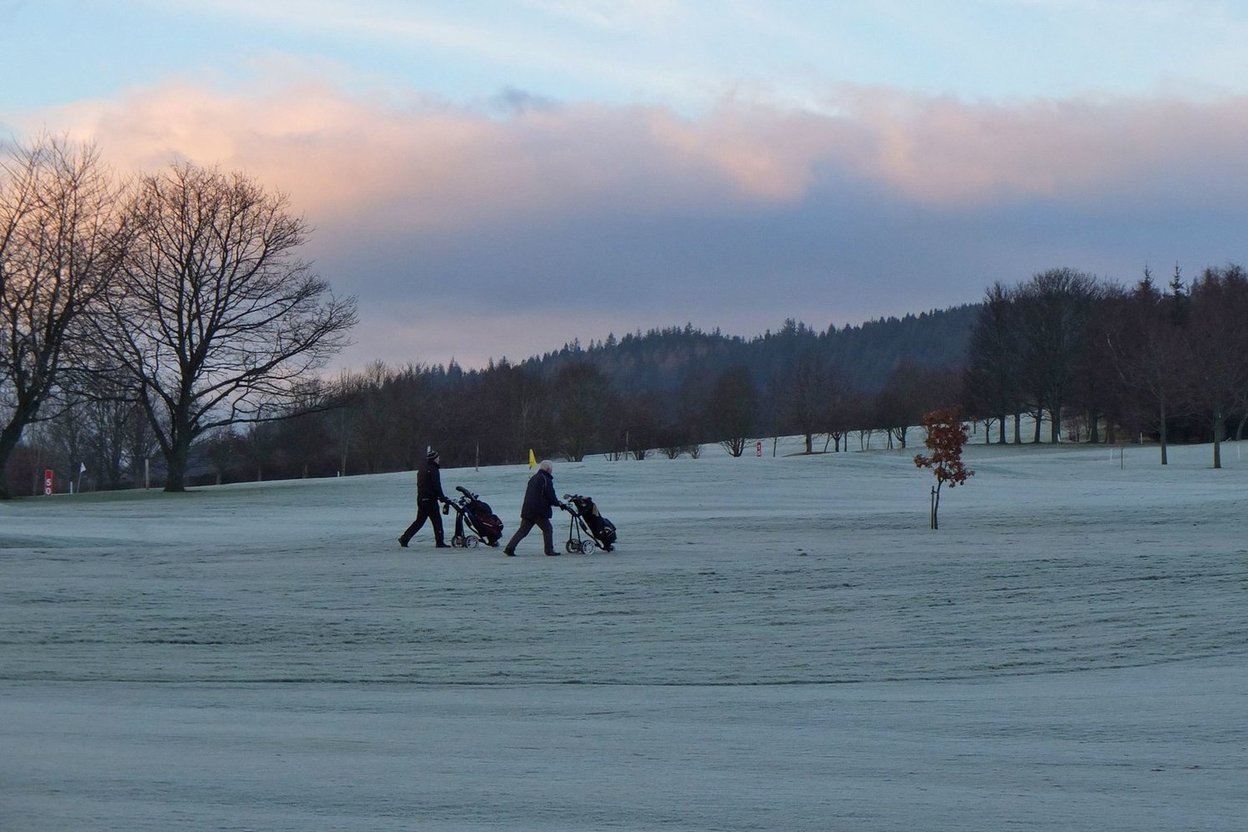
Walking on frosted grass breaks the frozen leaf blades, and the damage shows up days later as brown footprints. Why courses hold tee times on frosty mornings and what that means for your lawn.
Jack · golf course superintendent·4 min read·October 3, 2026
Every fall I'd stand at the first tee at sunrise with a line of golfers asking the same question: "It's just frost. Why can't we go out?" The answer is that a footprint on frosted grass isn't just a footprint. It's a few hundred broken leaf blades, and on a putting green, it's a track of dead grass that shows up two or three days later.
A blade of grass is mostly water. On a cold, clear night, the leaf surface drops below freezing and ice forms on it and inside the plant's cells. A frozen blade is stiff and brittle.
When you step on it, the frozen tissue cracks. The cells rupture, the blade can't recover, and over the next couple of days it turns brown. A golfer walking a green on a frosty morning leaves a trail of dead footprints that everyone else putts over for a week. A cart driving across a frosted fairway leaves two brown tire tracks.
Once the frost melts and the plant thaws out, it's flexible again and you can walk on it without hurting it.
Frost usually burns off within an hour or two of sunrise, faster on a sunny morning, slower in shady spots or low areas. So most courses hold tee times until the grounds crew says the frost has lifted. That's why tee times on cold mornings slide back, and why the first groups out sometimes play the holes in a different order to stay out of the shade.
Some courses lightly irrigate greens before dawn to melt frost faster. It only works in some conditions; on a very cold morning, the water can just freeze too.
The same thing happens in your yard:
Frost is a short-term thing. Dormancy is the long-term state cool-season grass goes into after a few weeks of cold, when it stops growing and turns tan. A dormant lawn can still be damaged by heavy traffic, especially when it's frozen, but it's not as fragile as a lawn that's actively growing and gets hit by an early frost.
The fall months, when the grass is still green and growing but nights dip below freezing, are when frost damage shows up most.
At home, the simple version is the same: let the sun do its work before you get out there. Your lawn will thank you in spring.
Once the season is winding down, see when to stop mowing for the season and how golf courses put greens to bed for winter.
Photo: Frosty morning on Peebles golf course - geograph.org.uk - 6348195 by Jim Barton, CC BY-SA 2.0.
Learn how golf courses kill grass at trees, fences and pavement to end string trimming. Covers mulch rings, edge strips and safe spraying.
What a superintendent does to get greens through a northern winter: raising mowing heights, fall feeding, topdressing, snow mold prevention, covers. Plus the parts that work at home.
These are the techniques that separate good home lawns from great ones. Used correctly, they deliver noticeable improvements in density, smoothness, and playability (or walkability) without the heavy chemical programs of the…